



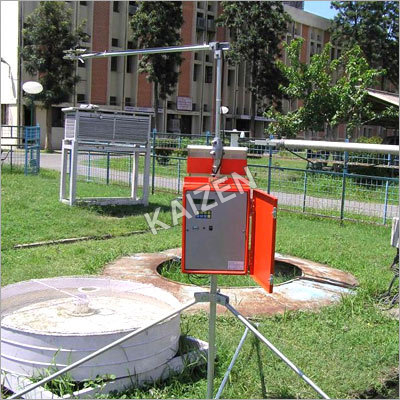
Digital Solar Radiation Recorder (Pyranometer)
Product Details:
X
Digital Solar Radiation Recorder (Pyranometer) Price And Quantity
- 1 , , Unit
- Factory calibrated to international standards
- Built-in recording capability
- Tripod or surface mount adaptability
- Weatherproof housing
- Based on thermopile sensor
- Measurement of Solar Radiation
- 0% to 95% RH non-condensing
- Digital Pyranometer
- -10°C to +50°C
- Standard 5 meters (extendable)
Digital Solar Radiation Recorder (Pyranometer) Trade Information
- Cash in Advance (CID), Cheque, Cash Advance (CA)
- 7-14 Days
- All India
Product Description
We explore an innovative perspective in the field of manufacturing and exporting an accurately designed variety of Digital Solar Radiation Recorder. With the support of multi disciplinary industrial skills and meticulousness quality, we design these recorders in various specifications. Widely used for measuring shortwave radiation, offered Digital Solar Radiation Recorder is mostly suitable for passive solar system analysis, irrigation scheduling as well as meteorological, hydrologic and other environmental studies.
Features
- Weatherproof
- Fast operation
- Wide usage
Digital Solar Radiation Recorder (Pyranometer)
This laboratory instrument is used to check the amount of solar radiations received by earth and records the value. Apart, this radiation recorder is ideal to measure the waves having the frequencies less than 1500KHz. Further, this instrument finds its usage in meteorological studies, passive solar system analysis, irrigation scheduling and the likes. Sensor: Calibration: 0.25 mV per W m-2, Range: 0 to 2000 W m-2, Wave Length Range: 300 to 1100 nm, Stability: 1 to 2% change over a 1 year period, Operating Temperature: - 40 to 55oC, Sensor Housing: Weatherproof anodized aluminum case with acrylic diffuser and stainless steel hardware. An ideal Pyranometer measures the entire solar spectrum, 280 to 2800 nm. However, about 90% of sunlight energy is between 300 to 1100 nm. Albedo measurement: Provided as per requirement.
Accurate Solar Radiation Measurement
Engineered for precision, the Digital Pyranometer utilizes a thermopile sensor to continuously monitor solar radiation levels. The data logger capability allows users to store high-resolution datasets without the need for external devices, making it a reliable choice for long-term monitoring in both laboratory and field environments.
Versatility in Mounting and Usage
Suitable for a range of installation scenarios, this pyranometer can be easily mounted on a tripod or directly onto flat surfaces. Its robust weatherproof housing ensures reliable operation in challenging climates, while the extendable cable offers additional placement flexibility, essential for various research and industrial projects.
FAQ's of Digital Solar Radiation Recorder (Pyranometer):
Q: How does the Digital Solar Radiation Recorder measure solar radiation?
A: The recorder uses a thermopile sensor to detect and convert incoming solar radiation into voltage, which is then measured and logged digitally. This provides precise solar irradiance data for research, energy analysis, or meteorological studies.Q: What benefits does a built-in data logger provide?
A: The integrated data logger allows automatic recording of solar radiation data without the need for separate data acquisition systems. This ensures continuous, reliable data collection and easy data retrieval for analysis.Q: When and where should I use this digital pyranometer?
A: This device is suitable for use whenever accurate solar radiation measurement is required, such as in solar energy projects, environmental monitoring, or weather stations. It can be operated indoors or outdoors, thanks to its weatherproof design and adaptable mounting options.Q: What is the installation process for the instrument?
A: Installation is straightforward; simply choose between tripod or surface mounting, set the device securely in your chosen location, and connect the power and data cables. The standard 5-meter cable can be extended if additional reach is needed.Q: How do I benefit from its weatherproof and wide environmental operating range?
A: With protection against harsh weather and an operating temperature range from -10C to +50C, the pyranometer ensures consistent performance and dependable data collection in varying environmental conditions, maximizing the reliability of your monitoring setup.Q: What does factory calibration to international standards mean?
A: Factory calibration ensures the instrument meets stringent accuracy requirements as per international protocols, leading to trustworthy and comparable solar irradiance measurements in all applications.Tell us about your requirement

Price:
Quantity
Select Unit
- 50
- 100
- 200
- 250
- 500
- 1000+
Additional detail
Mobile number
Email

Other Products in 'Meteorological Instruments' category

Contact Details
- India Address: B-1/6128, Dev Nagar, Karol Bagh,New Delhi - 110005, India
- Phone : 08045802393
- Russia Address:
Prospekt Lunacharskogo 11-3-17
Saint-Petersburg 194354 Russia
- Mr. Tarun Tirath
- Mobile : 08045802393
- info@kaizenimperial.in
 Send Inquiry
 Send Inquiry
 Send SMS
-

-

Follow Us on 


 |
KAIZEN IMPERIAL
All Rights Reserved.(Terms of Use) Developed and Managed by Infocom Network Private Limited. |
